Armoury Chamber
Ecclesiastical attire, pictorial and ornamental embroidery of the 14th - 18th centuries. Russian royal garment in the 16th - early 20th century
On display in Hall 6 is a collection of vestment that belonged to Russian metropolitans and patriarchs as well as ceremonial clothing of Russian tsars, emperors and empresses.
Vestment of Russian hierarchs, decorative embroidery, most of which came into the collection of the Armoury Chamber from the Patriarch's Sacristy of the Moscow Kremlin, Moscow churches and monasteries. That precious hand-made fabric was produced by masters of the Orient, West Europe and Russia in the 16th-17th centuries, now presenting exceptional historical, cultural and artistic value.
The gem of the secular dress collection of the 16th-17th centuries is a parade garment of Peter the Great— fitted caftan, luxurious state robe and a famous 'black Dutch suit'—an excellent example of a sudden transition from national Russian to European dress style in the 17th-18th centuries.
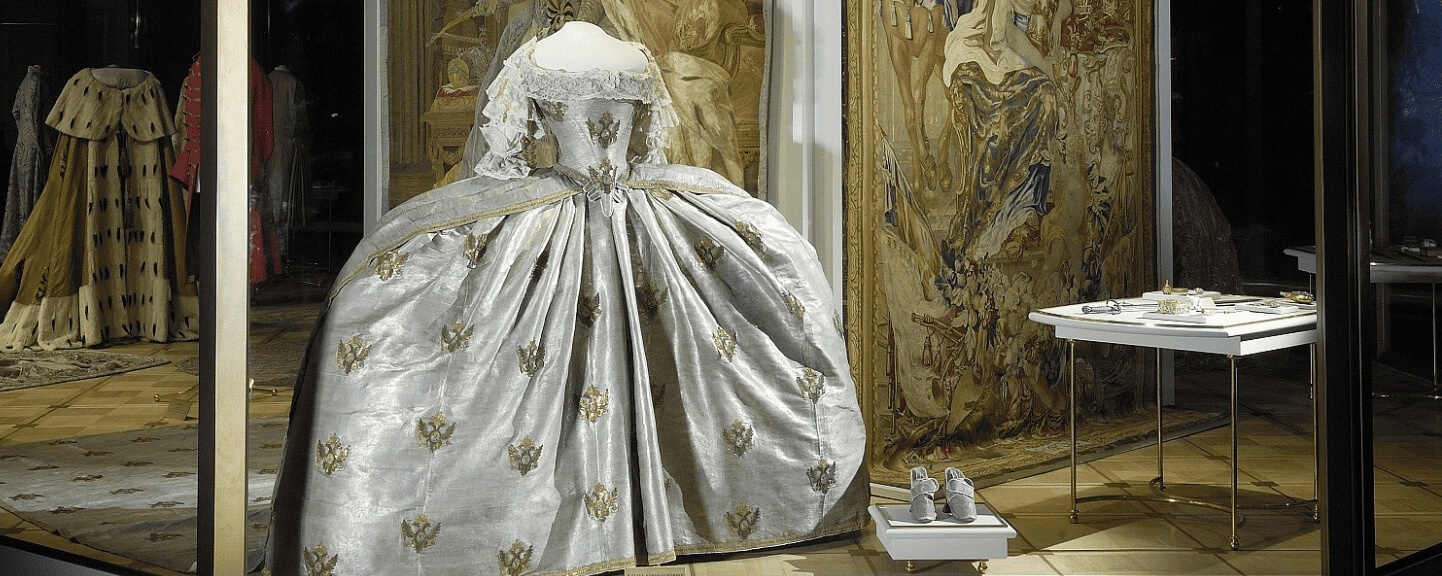
Coronation dresses and mantles of Russian emperors and empresses were an essential feature of court ceremonial; they remind of significant events in the history of the 18th and 19th-century-Russia and help to trace the development of court dresses.
Showcase 44. Secular dress in the 16th - 17th-century Russia
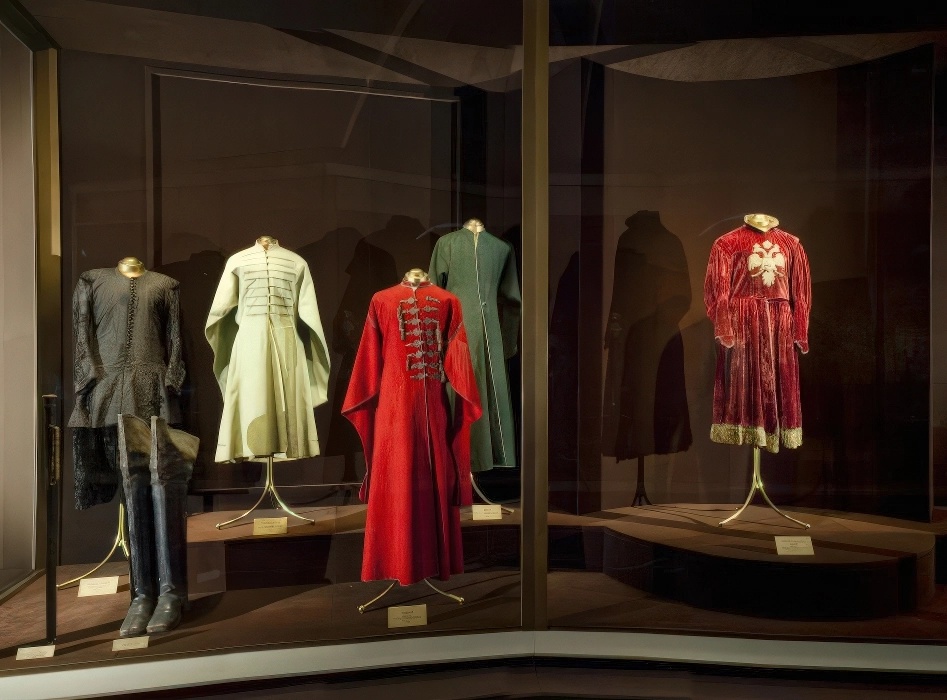
The exposition in this showcase presents the main types of secular dress and accessories of the 16th -17th centuries. Ceremonial items of everyday life at the Tsar's court illustrate general features characteristic of Russian national costume and in addition are connected with specific historical figures. The collection includes homespun coat (zipun), kaftan, fur coat, robe (ferezeja), state robe (platno), net cap (volosnik), boots and etc. which are extremely rare specimens of secular attire of Medieval Russia.
The style of most of the clothing of the pre-Petrine age (with the exception of courtiers' and officials' dress) was the same for all the segments of population. Garments of the nobles differed from that of common people mainly in the quality of the fabric, decorations and a number of items worn. Various social classes wore clothes made of linen, coarse coloured cotton and homespun wool. Precious textiles and ornamental embroidery were used for trimming the attire of Tsars and boyars.
The earliest item of clothing in the collection of the Moscow Kremlin Museums is Metropolitan Philip's fur coat—a unique specimen of 16th-century Russian popular dress. It is made of dark-brown homespun wool and sheepskin liner. The metropolitan wore this coat during his exile in the Otroch-Uspensky Monastery in Tver. Fur coats were very common in Russia and were worn by all the social groups. The peasants made them from sheepskin leather or hare fur, the boyars and clergy—with a sable, marten or white fox liner. A collar and cuffs were made of fur. With the fur coat, they wore tall straight hats made from the neck fur of a marten, sable or fox.
A rare item of clothing, of which only one has survived, is the armour dress (nalatnik) which was worn over ceremonial armour. It resembles a loose jacket with short sleeves. The specimen on display is made of red satin thickly covered with gold embroidery. It belonged to Tsar Mikhail Romanov.
The main type of male upper garment in mediaeval Russia was homespun coat (zipun), worn over a long shirt. Long narrow sleeves gathered at the wrist with hooks. A smallish round collar was attached on top. Zipun was encircled at waist several times by an oriental belt. Here one can see the domestic zipun of Peter the Great, made of green satin and quilted lengthwise with strips of wadding.
The largest group of garments on display is the group of a kaftan, a long-skirted coat which was worn over a zipun. The earliest specimen is a 16th-century oriental kaftan. It is made of pale blue Persian satin. The pattern, woven in silk and gold, shows a man fighting a dragon. Oriental kaftans differed little from those accepted in Russia and were often worn without any alterations. On display, you can see three figured kaftans belonging to Peter the Great, which were made at the end of the 17th century in the Kremlin workshop. They are similar in style, adorned with a silver-gilt lace and made of white watered and pinkish, dark red silk and pale blue wool.
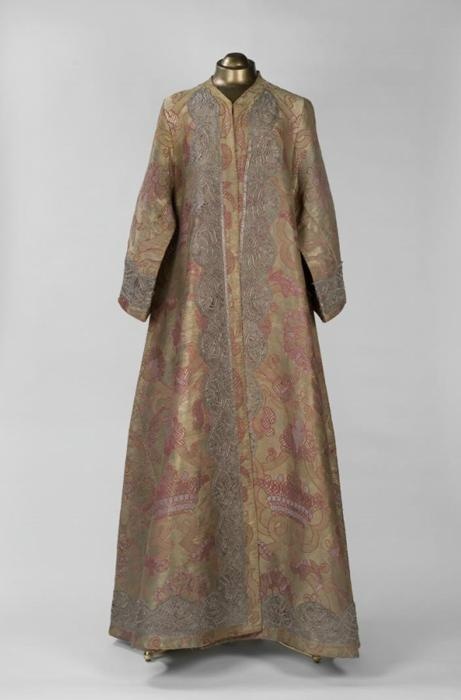
State Robe (platno) of Tsar Peter Alexeevich
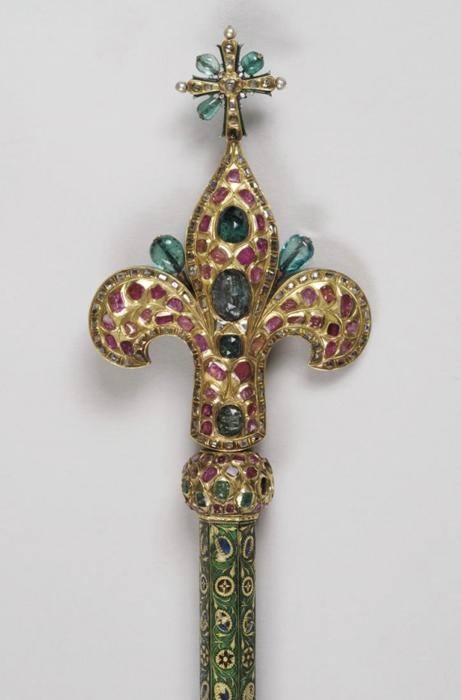
Staff of Tsar Alexey Mikhailovich
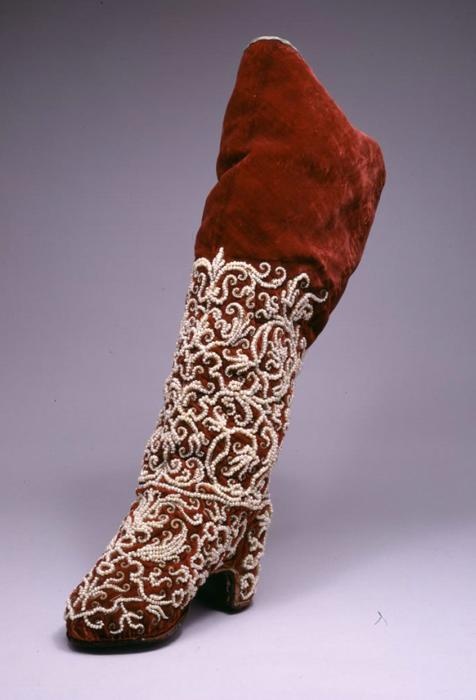
Boot
Showcase 45. Secular dress in Russia of the 18th - early 20th century
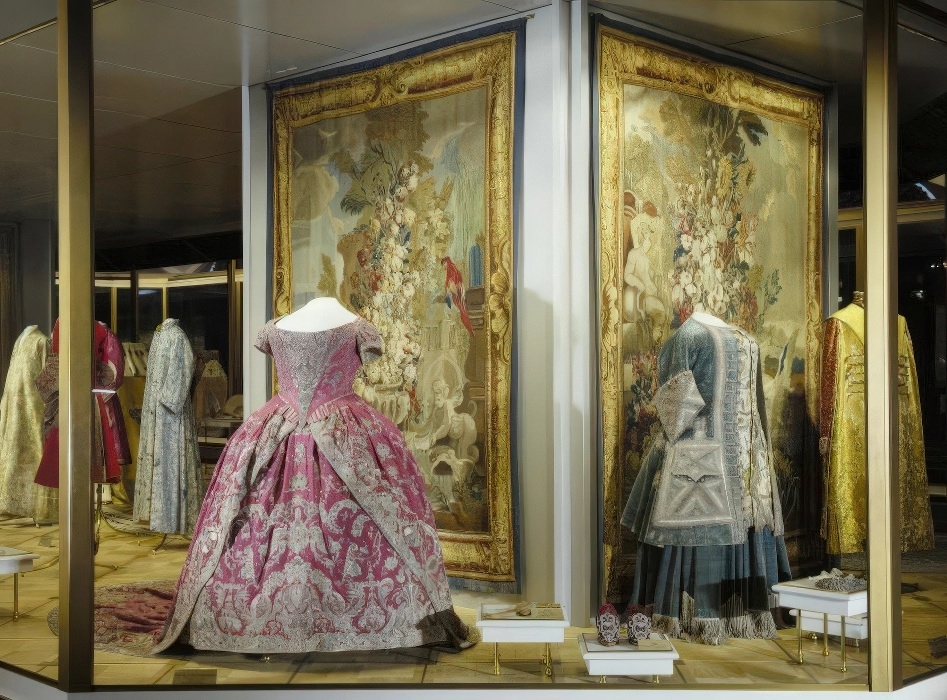
The showcase presents coronation dresses of Russian Empresses, full uniforms and coronation mantles of Emperors, the wardrobe of Peter II, masquerade costumes of Catherine I and Nicholas II and various accessories, i.e. fans, lorgnettes, snuffboxes, watches, swords and walking sticks. The collection reveals both noteworthy aspects of Russian history as well as the development of secular dress in Russia in the 18th-19th centuries.
Until the beginning of the 18th century, the Russian people wore a national costume. In 1700-1701 Peter the Great issued an edict to replace traditional Russian dress by fashionable European clothing. Long Russian garments gave place to short kaftans and camisoles. In addition to them, a male dress of the first half of the 18th century consisted of breeches and a shirt trimmed with lace, as well as stockings, shoes, hat and other accessories. The kaftans of Tsar Peter II were made in French fashion at the beginning of the 18th century. Executed of velvet, brocade and wool, they were richly trimmed with gold and silver threads and lace.
Women had to give up their plain dresses (sarafan) and sleeveless jackets, which concealed the forms of the body and replace them by dresses with very low necklines and short sleeves. European dress required a variety of coiffures and therefore traditional headdresses under which women hid their hair were no longer used. Having previously led a secluded life at home, women now received the right to attend various celebrations, parades and so-called assemblies (a new type of meeting introduced by Peter the Great with food and dancing). Two coronation dresses on display, which belonged to Russian Empresses Catherine I and Anna, were made in the style fashionable in Europe at the beginning of the 18th century. The dresses have a close-fitting bodice, typical of female dress throughout the whole 18th century, a low-cut neckline, very small short sleeves and a wide bell-shaped skirt. In order to produce this bell shape, whalebone hoops were sewn into the underskirt. This type of skirt remained in fashion until the 1760s and was known as a pannier skirt.
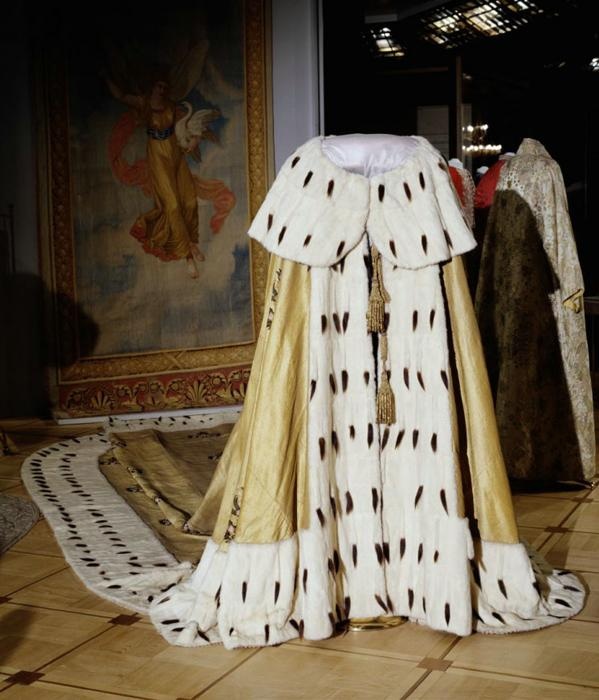
Coronation Robe of Empress Alexandra Fyodorovna
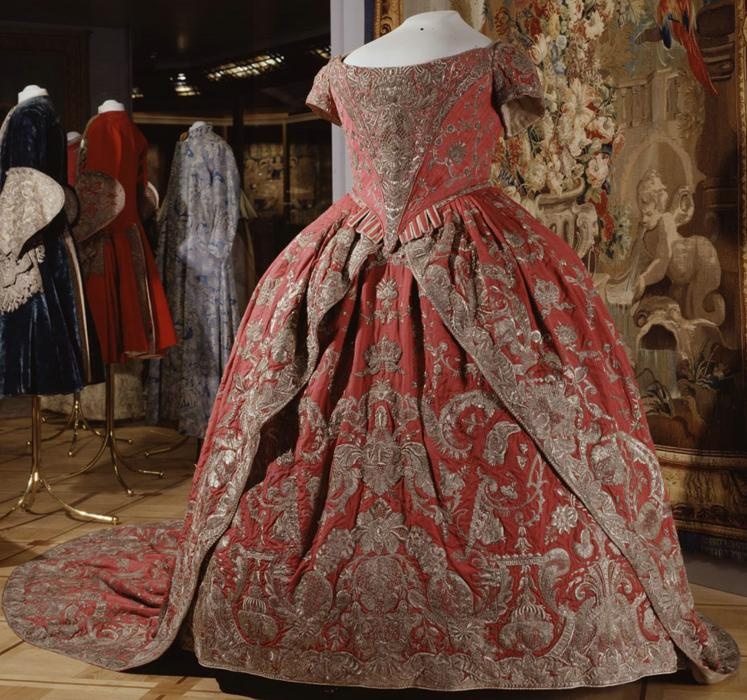
Coronation Dress of Empress Catherine I
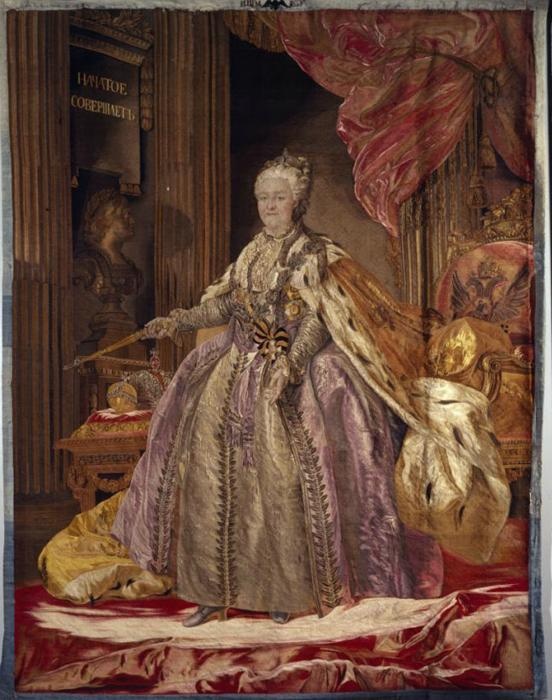
Tapestry ‘Portrait of Empress Catherine II’’
Showcase 46. Precious fabrics from Byzantium, Persia and Turkey of the 14th - 18th centuries
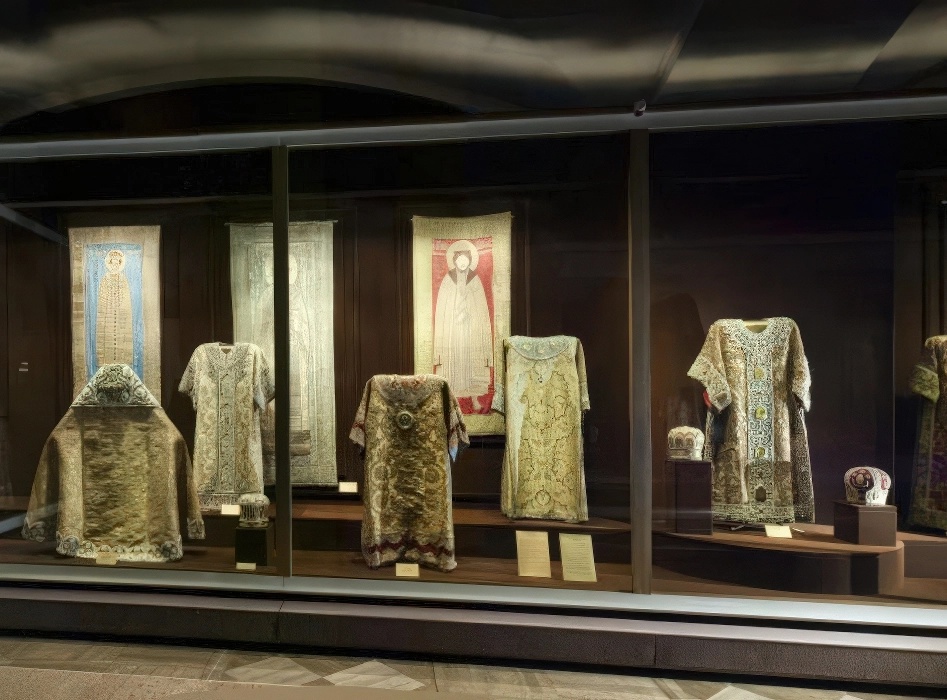
There was no regular production of precious fabric in Russia up to the 18th century. Expensive custom-made textiles were brought to Russia by merchants and embassies. The earliest precious fabric in the Armoury collection is a Byzantine cross-patterned satin worn by clergymen and other embroidered clothes of the Russian nobility. The ‘major’ (‘bolshoy’) sakkos of St Photius the Metropolitan and the ‘minor’ (‘maliy’) one, which may also have belonged to him, are made of Byzantine fabric. The ‘minor’ sakkos is embroidered with the figure of Metropolitan Peter. And the ‘major’ sakkos is embroidered with coloured silk, gold and silver threads with the portraits of Grand Prince Vassily of Moscow, his wife Sofia, their daughter Anna and her husband (future Emperor John V Palaiologos of Byzantium) and also the portrait of St Photius himself. All the portraits are framed with pearls. The portrait of the Russian Prince together with the Emperor of Byzantium testifies to the growing importance of the Moscow state.
In the 16th-17th centuries, permanent trading relations were set up between the Russian state and both Persia and Turkey. Silk fabric from the Orient was held in high esteem at Tsars' court. Persian fabric in the Armoury collection dates back to the 17th century, a period which saw the flowering of Persian weaving. Persian satin, velvet, taffeta, damask and brocade of delicate colours (pale blue, pale pink, light green) were usually decorated with a foliate ornament — carnations, tulips, narcissi, irises and hyacinths. Silk cloth woven with very fine gold or silver threads was called altabas (brocade). This fabric, tight-woven and stiff, gave the impression of being cast from metal.
There was also a great demand for Turkish fabric in Russia in the 17th century. Represented in the Armoury collection, Turkish satin, velvet and brocade stand out for their ornamentation and bright colours. As for Persian fabric, a foliate design predominated, but the pattern was larger and more colourful. One often finds ornaments in the form of twelve-pointed stars and carnations in full bloom. The pomegranate was regarded as a symbol of good fortune. The larger the pattern, the higher the fabric was prized.
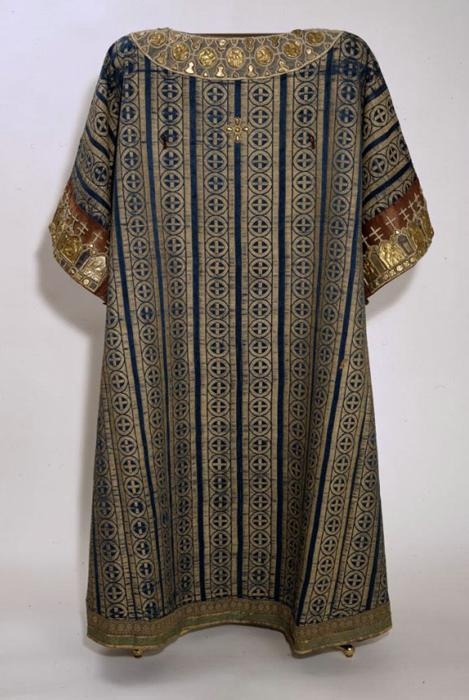
Sakkos
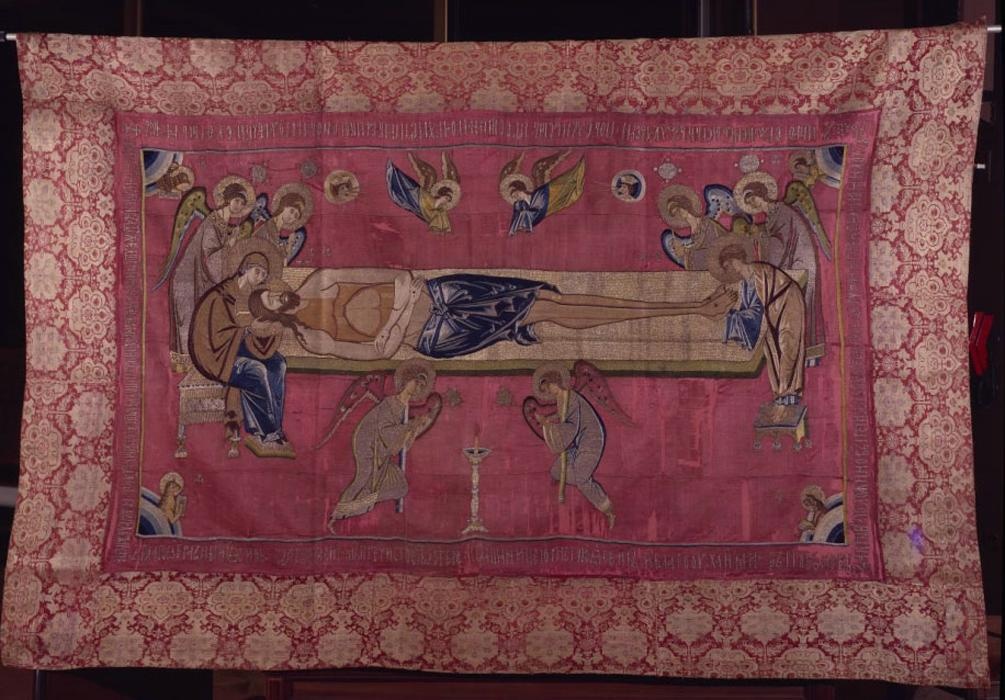
Shroud ‘The Entombment’
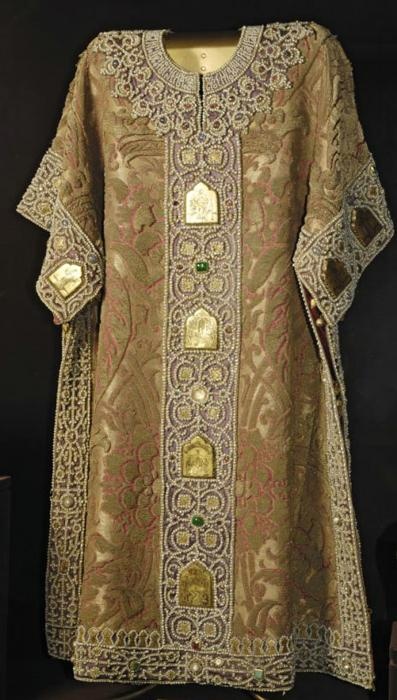
Sakkos