Armoury Chamber
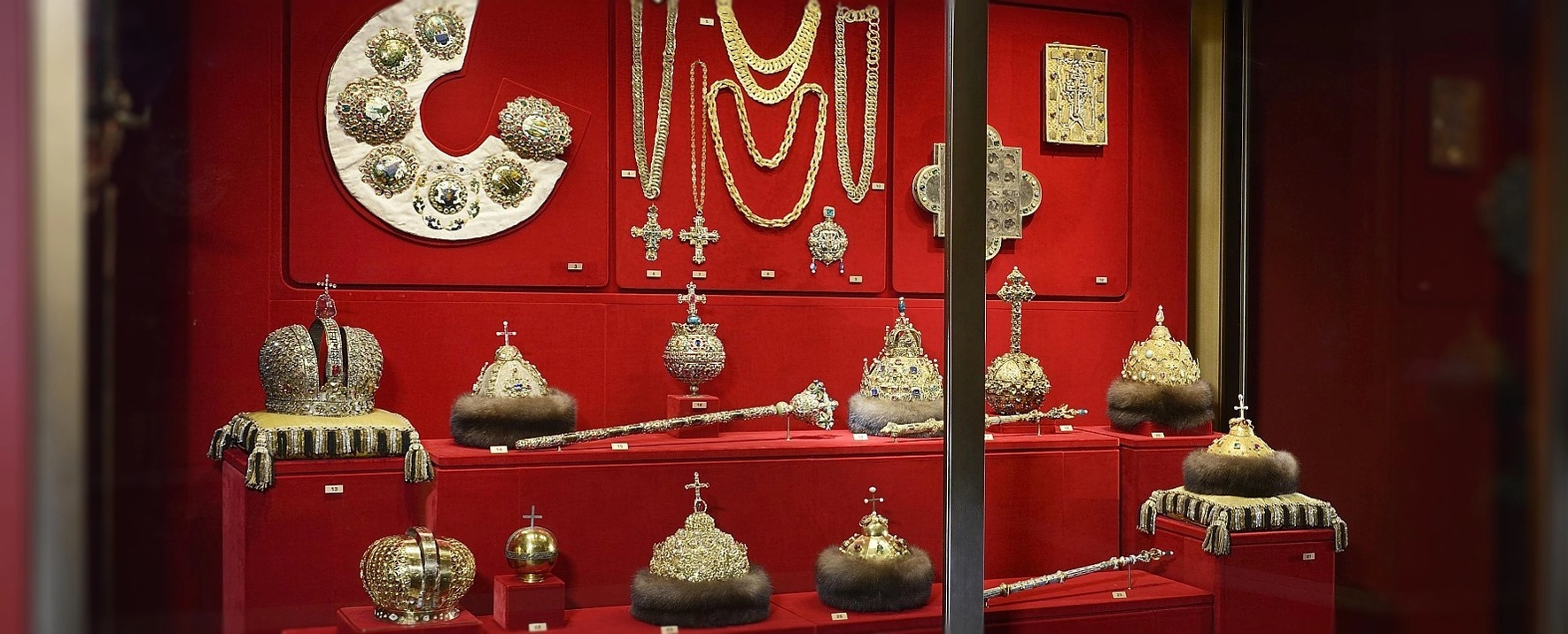
Ancient state regalia and ceremonial items of the 13th - 18th centuries
A unique historical and cultural complex of state regalia of the 14th-17th centuries displayed in the hall has been formed on the base of the most ancient part of the Great Princes’ and Tsar’s treasury.
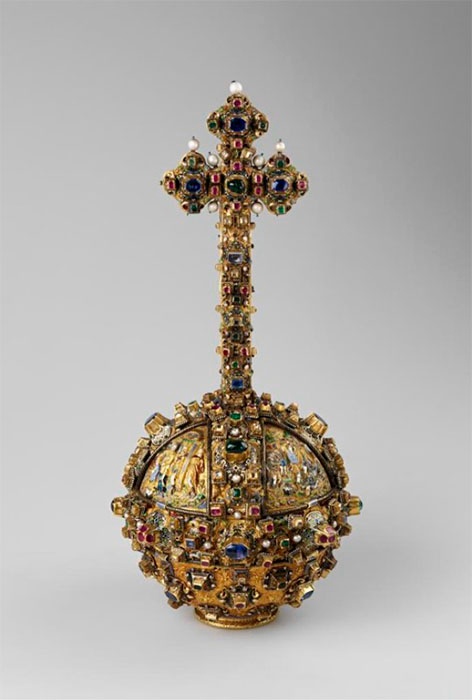
Crowns, barmy (regalia collar), sceptres, orbs and other insignia were an essential part of court official ceremonies, such as setting for reigning, diplomatic receptions and coming out of Russian Tsars. Many of those regalia became hereditary and soon assumed importance as political symbols. The complex includes a well-known 'Cap of Monomakh'. Up to the early 18th century, the sovereigns were crowned with the Cap. This collection of ancient Russian regalia is the largest in Europe.
The unique thrones of the Russian sovereigns form a significant part of the collection as well.
Showcase 47. Thrones of the 17th century
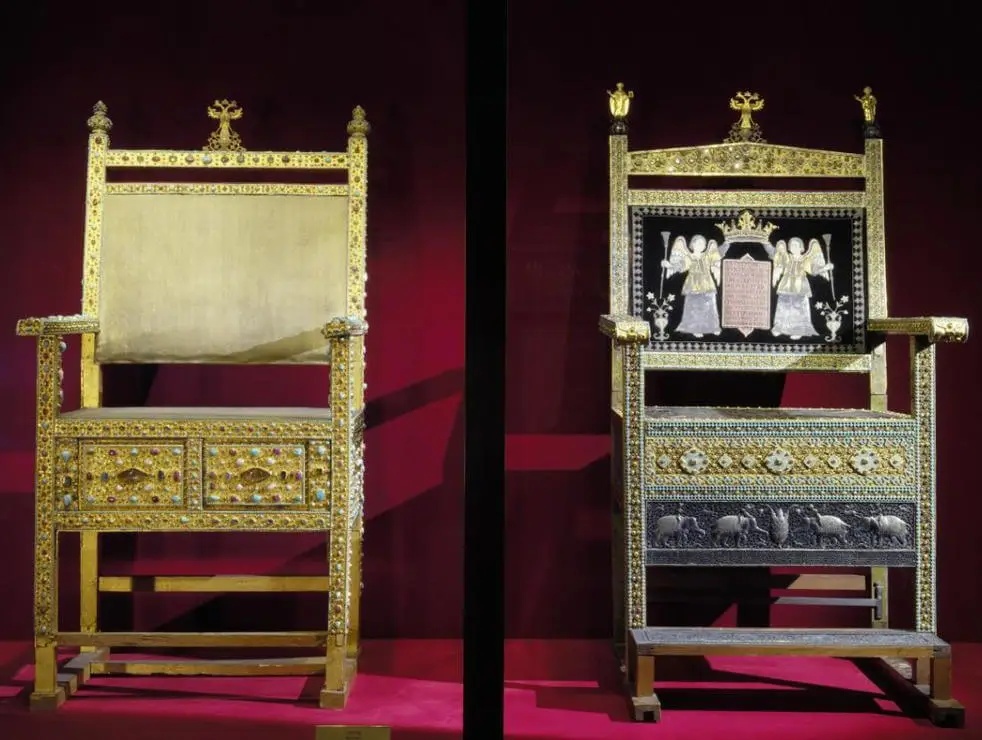
Thrones played an important role in official ceremonies in the 17th-19th centuries. In the 18th century, thrones stood on a high stepped dais beneath a canopy and were often the only pieces of furniture in the enormous hall.
On display are two thrones of the first tsars of the Romanov dynasty. The throne of Tsar Mikhail Feodorovich was executed at the beginning of the 17th century from the old chair of oriental workmanship which had belonged to Ivan the Terrible. In its form, high back and arms, it resembles Russian armchairs, but oriental motifs still remain in the ornament. The throne is faced with embossed gold and adorned with rubies, pearls, turquoises and other uncut stones.
The shape of the so-called ‘diamond throne’ of Tsar Alexey Mikhailovich, the most elaborate of the Royal thrones in the Armoury collection, is reminiscent of the throne of Tsar Mikhail, his father. Granted to the Tsar by the Armenian Trading Company in Persia in 1660, the throne is made of sandalwood faced with gold and silver plates with foliate ornamentation. Its seat is decorated with a bold carved pattern depicting a procession of elephants and mahouts on their backs. The back of the throne is covered with black velvet and embroidered images of two genii supporting a crown over the inscription glorifying the Tsar and his power. The whole surface of the throne is faced with an intricate mosaic of turquoises and diamonds.
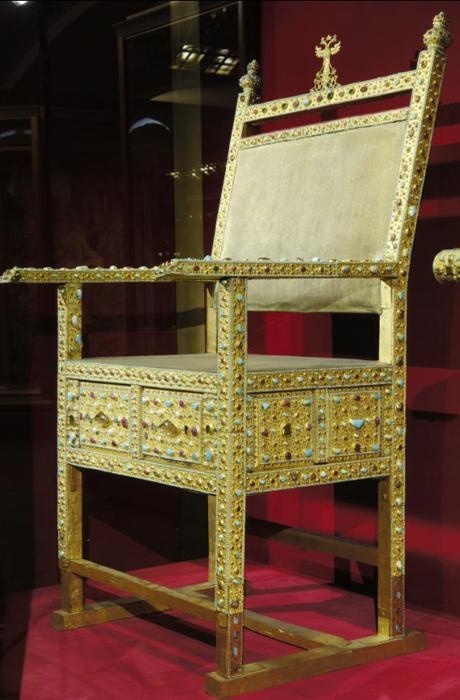
Throne
Moscow Kremlin Workshops, before 1642
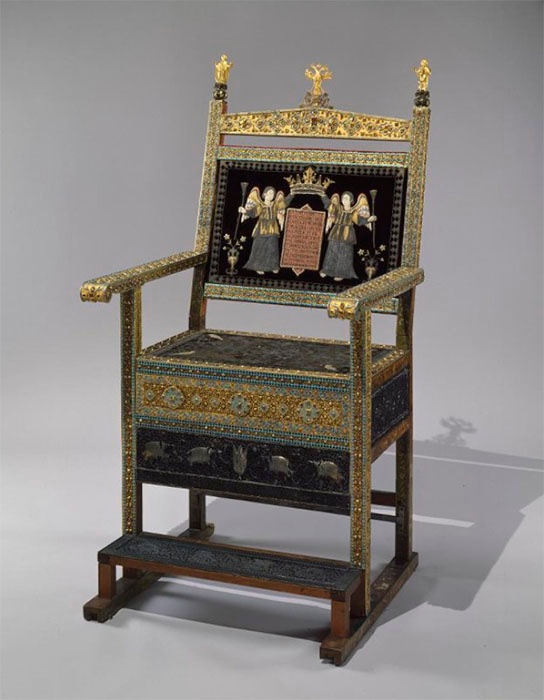
Diamond Throne
Iran, 1659
Showcase 48. The double throne of the late 17th century
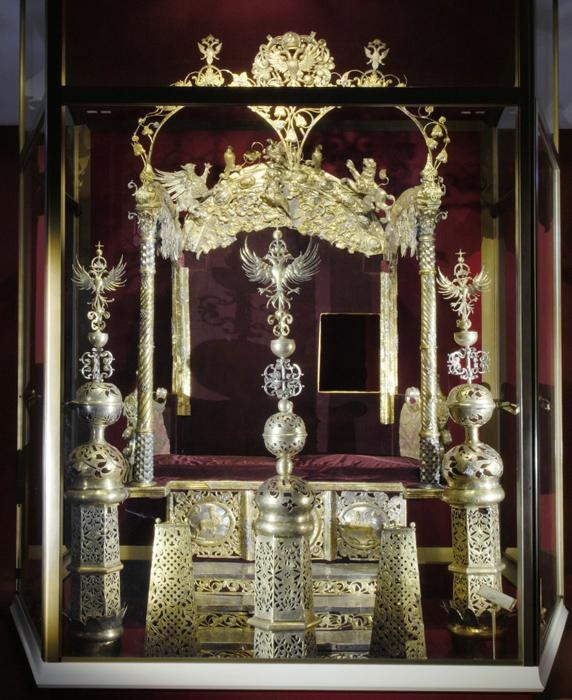
An outstanding masterpiece is presented in showcase 48—the Double Throne with three armorial pillars and two orb stands of Tsars Ivan and Peter, sons of Tsar Alexey Mikhalovich. It serves as a vivid illustration of the unique historical moment when two tsarevitchs were crowned simultaneously. Tsar Alexey died leaving three sons. After the death of the eldest one, Feodor, a fifteen-year-old Ivan should have inherited the throne, but he was feeble-minded and in poor health. So it was decided to crown the two brothers together, Ivan and a ten-year-old Peter (future Emperor Peter the Great). The double-seated throne was executed especially for the occasion by the Kremlin craftsmen in the 1680s. Its constriction including an open-work arch on twisted columns, silver steps below and a high back with two silver pillars on each side resembles elegant architectural forms. The necessary instructions and advice were transmitted through a small orifice cut into the back of the throne and concealed by velvet covering. The shape of the throne is finished with lavish ornamentation. An openwork embossment, three-dimensional animal figures, carving and high relief, contrasting combination of silver and gilt are the exemplification of the Baroque style.
Showcase 49. Throne chairs of the 18th century
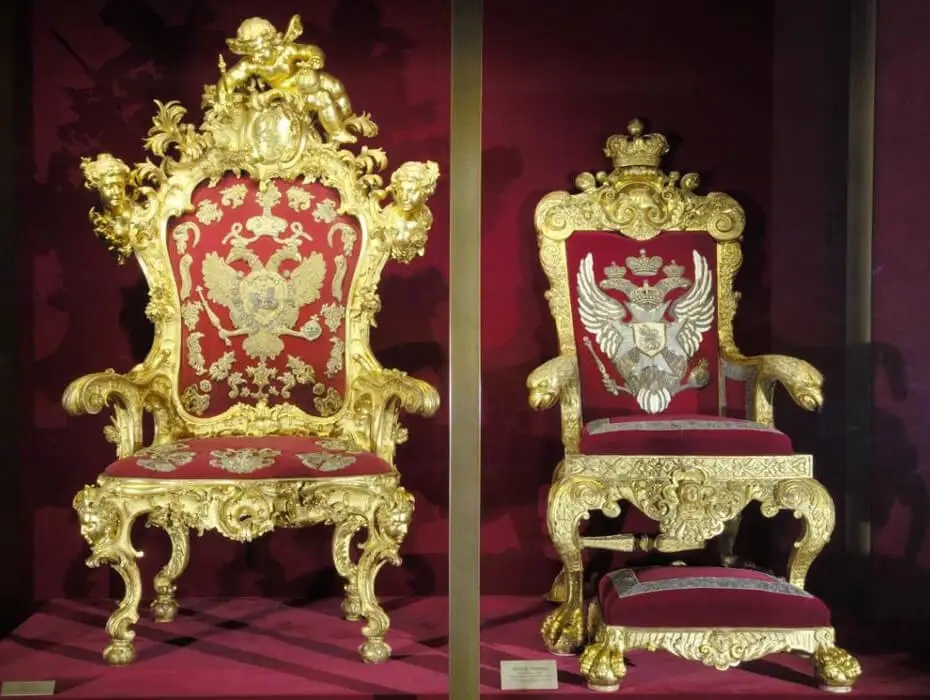
In addition to the collection of 16th- and 17th-century thrones, there are also some throne chairs. They were used at coronations and on other special occasions. The most interesting are the 18th-century throne chairs of Empress Elizabeth (1742) and Emperor Paul I (1796).
Artwork of both baroque and rococo styles is the throne of Empress Elizabeth, the daughter of Peter the Great. It is elegant in its form and very attractive in decoration. Its curved legs and arms are adorned with carved flowers and grasses as well as with charming female heads. The throne's official function is emphasized by splendid ornamental embroidery with the State emblem and Elizabeth's monogram on its back. This combination of the insignia of power with the whimsical elegance of carved wooden scrolls indicates the fact that the throne belonged to a woman.
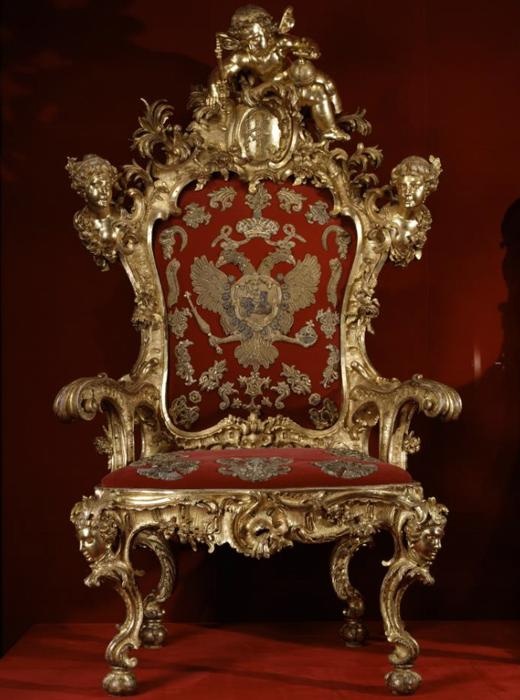
Throne Chair
Russia (?), mid 18th century
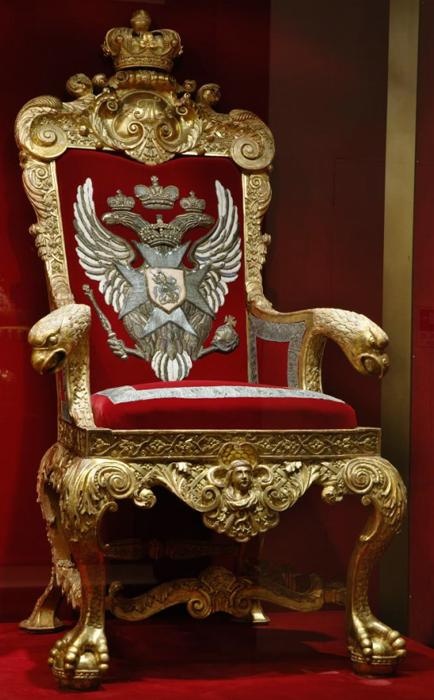
Throne Chair
Russia, Saint Petersburg, 1799-1801
Showcase 50. Ancient state regalia and ceremonial items
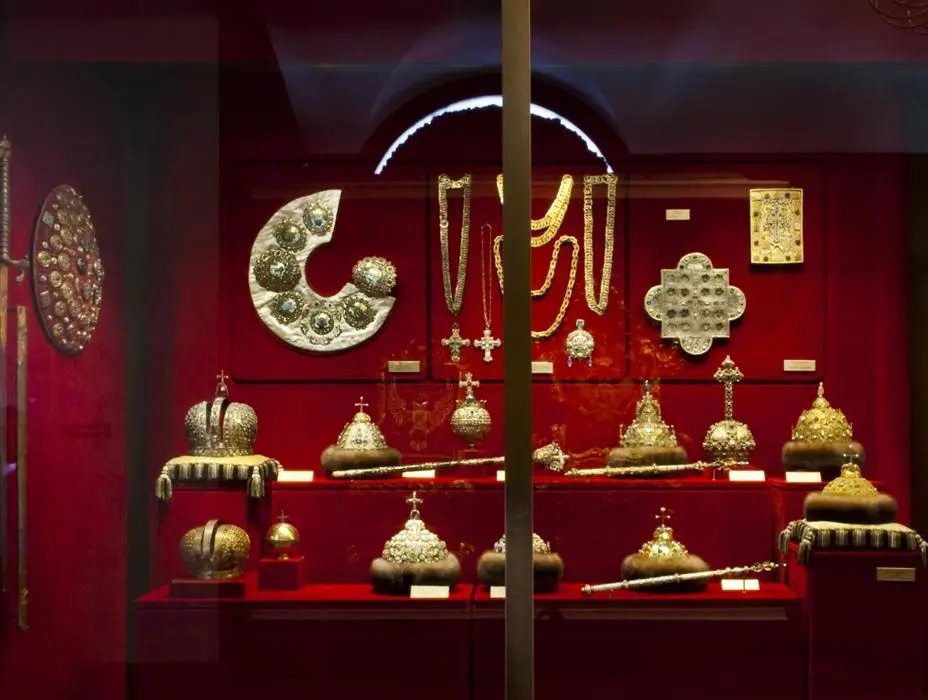
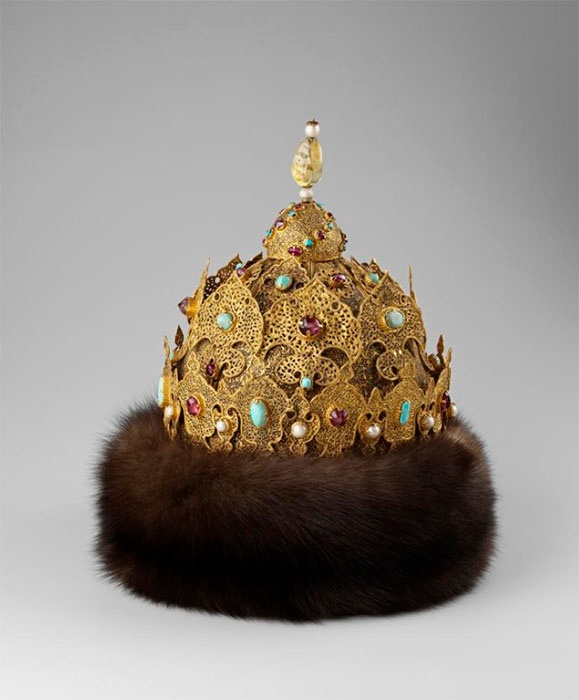
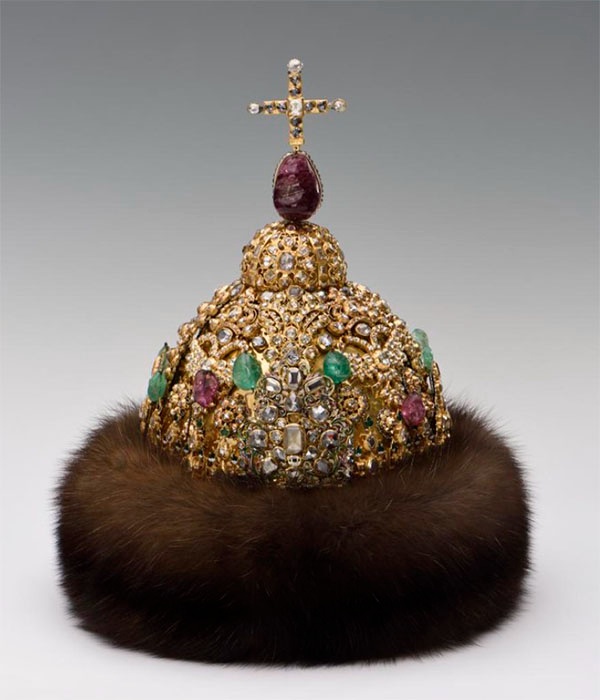
The oldest item in the collection is the Cap of Monomakh, used in the ceremony of crowning a monarch in Russia. Its name is connected with a Russian legend of the 15th century, according to which it has been brought to Russia in ancient times as a gift from Byzantine Emperor Constantine Monomachos. The Cap is of oriental workmanship of the late 13th and early 14th century. The question of its origin is still unspecified. The oldest section of the Cap consists of eight gold plates adorned with very fine gold lace in a pattern of six-pointed rosette-stars and lotus blossoms. The semi-spherical top with the cross, the sable trimming, and the pearls and precious stones belong to a later period. The Cap weighs 698 grams and is the lightest of all those in the showcase.
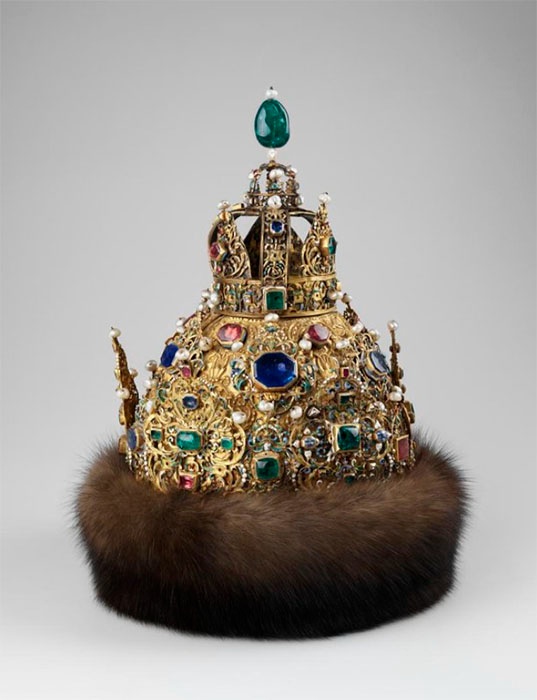
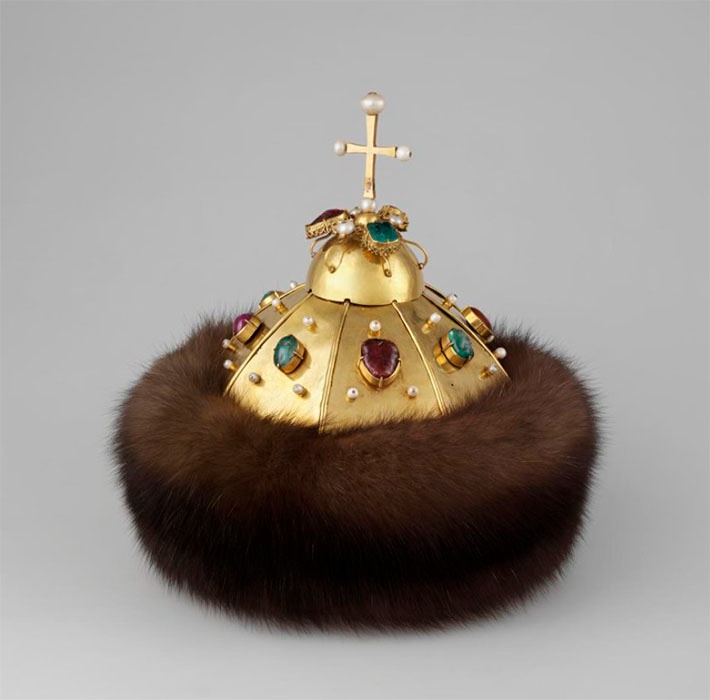
The first documentary references to the coronation at which the Monomakh's Cap was used date back to 1498. The last time the Cap was used for that purpose was in 1682, when two tsars, Ivan and Peter, were crowned simultaneously. The eldest brother Ivan was crowned with the Cap of Monomakh of the "first set", while Moscow craftsmen made a "second-set" replica of the Cap for Peter. It was similar in form to the old one but inferior in artistic qualities. There was a rule that the Cap should be worn only once in a lifetime, for the coronation. For other solemn occasions, each Tsar had his own ceremonial crown. The showcase also contains other royal crowns, including the Cap of Kazan, gold crown of the famous "Grand Set", diamond crowns of 1682-1689.
Barmy—a broad detachable regalia collar covering shoulders and adorned with sacred images, pectoral decorations, such as crosses, Panagia and chains—was an essential part of ceremonial attire of Grand Princes and later of Tsars in Russia. The showcase contains chains made with remarkable skill, such as the one consisting of eighty-eight flat rings decorated with niello, enamel and a carved inscription of Tsar Mikhail Romanov's full title. On display, there is a State sword and shield. They began to be used as part of the royal regalia at the end of the 17th century. The round shield is made of wood covered with red velvet and adorned with figured appliqué work of jade and rock crystal, as well as inlaid with precious stones and bright enamel.
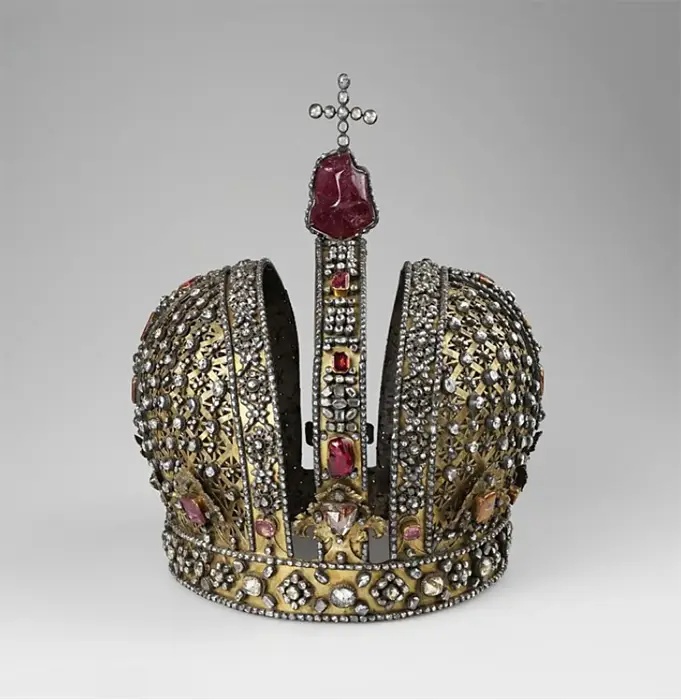
Under Peter the Great, Russia had been declared Empire in 1721. The coronation rite changed, the old type of cap-crown was replaced by an ordinary crown and a humeral, a special purple mantle called porphyra. Showcased are the crowns that belonged to Empresses Catherine I and Anna Ioannovna. One of the first new-type Russian crowns was executed by Gottlieb Wilhelm Dunkel in St. Petersburg in 1731 for Empress Anna's coronation ceremony. It is made of silver and adorned with about 2,500 diamonds and an enormous tourmaline. The form was to become traditional—two open-work hemispheres divided by a movable arc with a cross in the middle and a broad circlet.
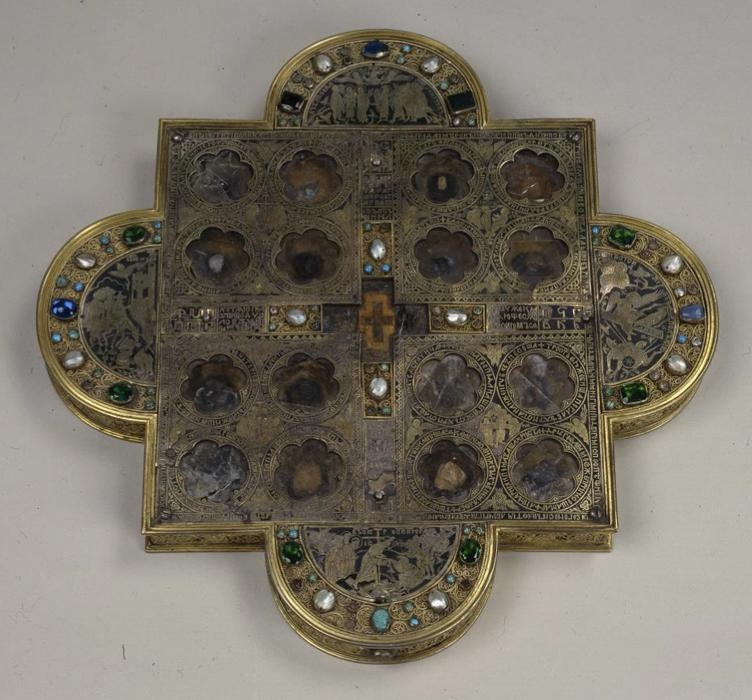
Reliquary
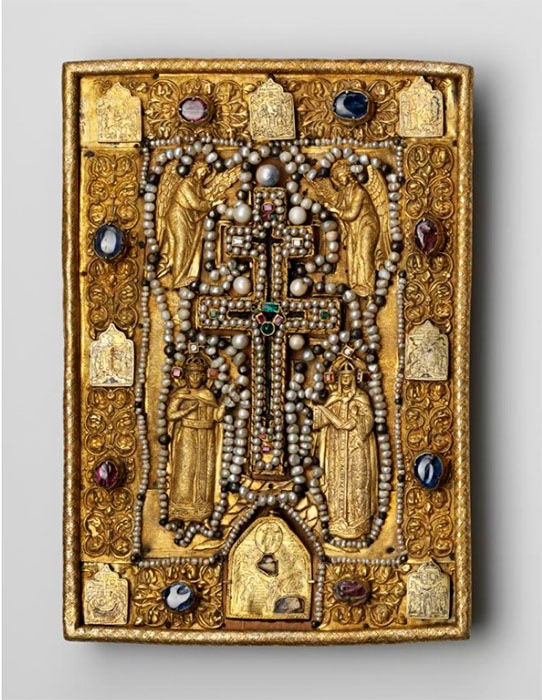
Icon with a cross and panagia
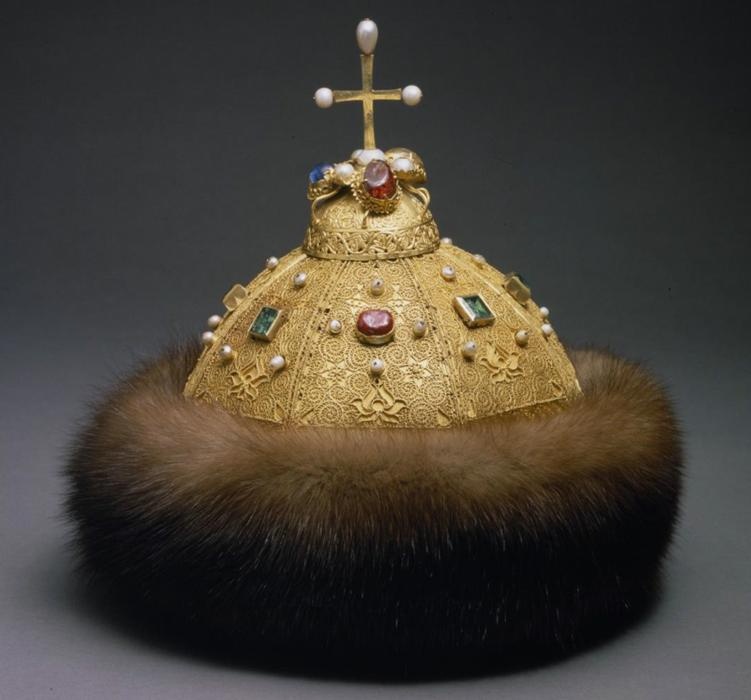
Cap of Monomach
Showcase 51. Thrones of the 16th century
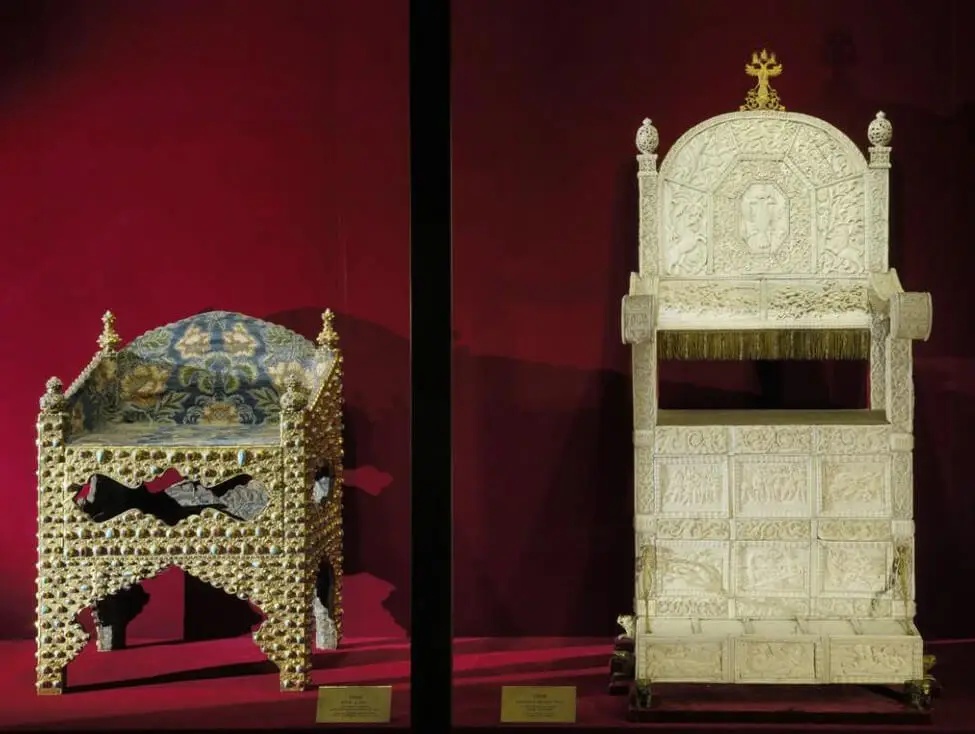
The earliest throne of the mid-16th century is represented in showcase 51. This fine specimen of Renaissance culture was made of wood faced with plates of ivory and walrus tusk; therefore, it was called "carved bone armchair". The carved ornament unites various subjects and representations into a single composition. Decorative scenes include images from both Greek mythology and the Old Testament. The depicted themes, the style of carving and the motifs, which include grotesques and Cupids, enable the researches to date most of the pieces to the 16th century and to attribute them to Western European Renaissance craftsmen. This bone throne has been renovated several times in Russia: worn pieces of bone were remade by local craftsmen; in 1856, on the occasion of the coronation of Emperor Alexander II, the throne was decorated with a silver-gilt double-headed eagle.
In addition to the bone chair, the showcase includes a throne of oriental workmanship executed in the late 16th century. Having been presented by Shah Abbas I to Tsar Boris Godunov, it was called "Persian throne with stones". The form of the throne with its low back flowing into sloping arm-rests reveals features typical of Iranian furniture of the 16th-17th centuries. The makers have used ornament beloved in the East, i.e. strips of gold decorated with a foliate pattern and coloured stones - blue turquoises, red rubies and tourmalines. The back of the seat, the arms and the whole lower section of the throne were covered with gold Persian fabric, replaced by French velvet in 1742 for the coronation of Empress Elizabeth.
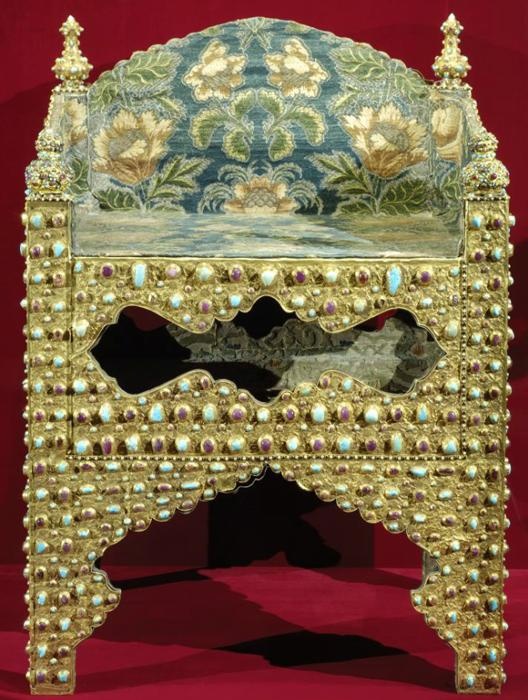
Throne
Iran, Isfahan, late 16th century
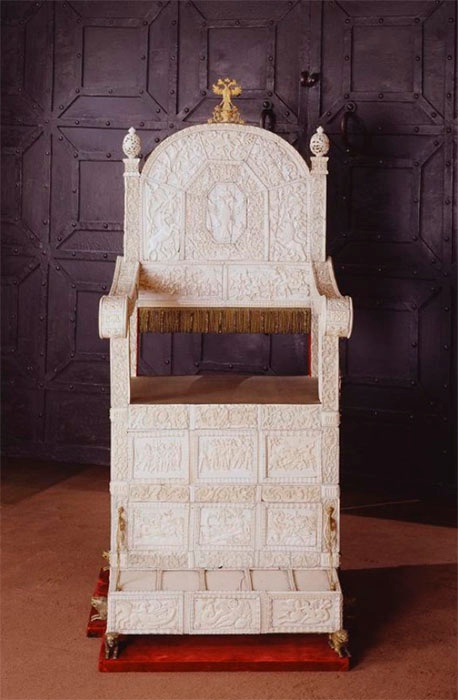
Throne
Western Europe, 16th - early 17th century